With a week before I head there, I’m frantically reading as much as I can about Newark. It’s not a place with a huge literary reputation, but I’m learning quite a lot. My first port of call was Philip Roth’s “American Pastoral“, often included in the canon of great 20th century American fiction. Roth was from Newark and the city is often the setting for his books. I’ve struggled with him in the past and I found “American Pastoral” difficult at times and some of its passages almost unreadable. There’s a fantasized sexuality that verges on pornographic that I found quite disturbing. That said, he knows his place. He depicts what, I expect, is a largely lost Newark of the 1950s, 60s and early 70s. These were seminal years in the American experience and Roth really captures that against the backdrop of a changing Newark landscape. He writes from the perspective of first and second-generation Jewish immigrants, many of whom settled in the Weequahic neighborhood, south of the city centre.
For Roth, the symbol of Newark’s decline were the “riots” (a contested term) in July 1967. But in his book, “Newark: A History of Race, Rights and Riots in America“, Kevin Mumford makes clear that the upheavals arose from a long history of institutional racism and political betrayal. The spark, as so many times before and since, was violent discriminatory policing visited on the city’s black community, particularly those living in public housing. These are among many points of comparison with the UK I’ll be discussing with scholars at Rutgers.
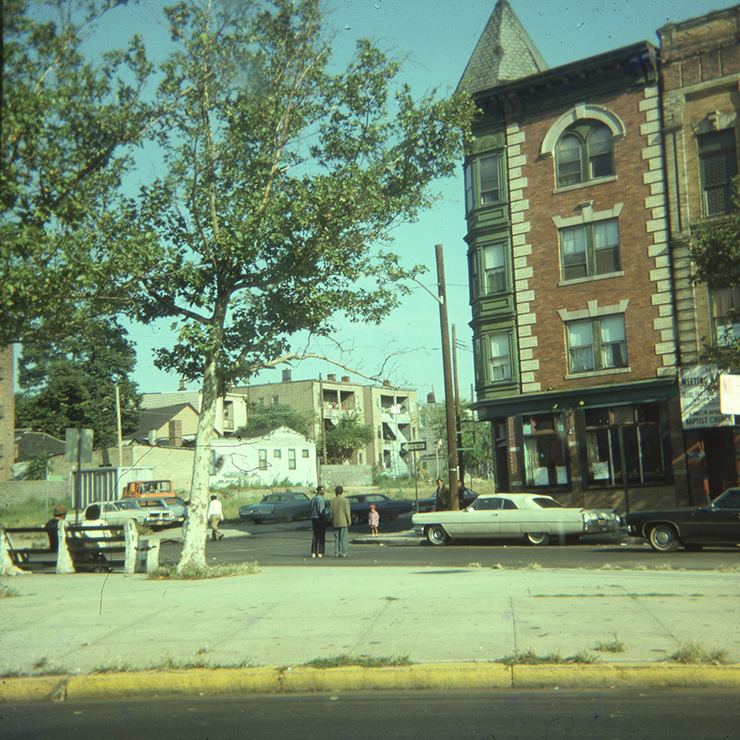
My second piece of Newark fiction is “Howard Street” by Nathan C Heard. Like Roth, Heard was a Newark native, but his experience was shaped by life in the old Third Ward black ghetto (it’s now called Central Ward and is where I’ll be living in university accommodation, which probably indicates something about how the area has changed). Also like Roth, some of Heard’s writing is very hard to read, with its relentless descriptions of violent misogyny. “Howard Street” was published in 1968 and was written while Heard was in prison. Perhaps that explains why he doesn’t directly address events the year before, when 26 Newarkers were killed, most of them African Americans shot by the police or National Guard. But Heard describes an urban dystopia that was bound to explode. So far, I’ve only got Google Earth to go on, but Howard Street looks like a place that has been thoroughly transformed from the place Heard knew. I’ll be taking a walk as soon as possible.
A key element in Newark’s history is the Great Migration, when millions of black people left the Jim Crow South for what they hoped would be a less racist, poverty stricken North. In her classic account, “The Warmth of Other Suns”, Isabel Wilkerson provides a short, but insightful summary of Newark:
“At daybreak, The Silver Meteor wound its way into Pennsylvania Station at Newark, New Jersey. The conductor called out the name of the station and the city, and after so long a ride through the night and now into day, some passengers from the South gathered their things and stepped off the train, weary and anxious to start their new lives and relieved to have made it to their destination at last. ‘Newark’. It sounded so tantalizingly close to ‘New York’, and maybe, some assumed, was the way northerners, clipping their words as they did, pronounced New York. It was confusing to have their intended destination preceded directly by a city with such a similar name and with an identically named station.” (p214)
I have a feeling that NOT being New York may be an important part of Newark’s identity.
Wilkerson adds that, by the end of the Great Migration in the 1970s, analysis of census data recorded Newark as the fifth most segregated city in the US. I will be looking to see signs of whether this has changed (although it is now a “majority minority” city).
There are two other important fields of Newark enquiry I’ll be following and they’re linked. Like other US cities, Newark has demolished much of its public housing. I remember seeing some of it, when it was still standing, in the early 1990s. To use the policy vernacular of the time, it was visibly “distressed”. But in many other places, demolition was not the solution. I’ll be interested to see if it has been in Newark, but I doubt it. However, as local writer and activist John Arena has chronicled in “Expelling Public Schools“, attacks on public housing often go hand-in-hand with attacks on public education, which John describes as part of a campaign of “accumulation by dispossession” (something he also observed and recorded in post-Katrina New Orleans).
Here is another UK parallel. In the mid. 2000s, Newark was at the forefront of a struggle for and against Charter schools, just as Islington (where my day job is) was against Academies. In both cases, the privatisation drive was led and funded by large corporate interests, aligned with opportunistic local politics. Although, to some extent, this is water under the bridge, I’m hopeful that my time in Newark will remind me that there are models of education and urban living that are not fixated with and dependent on market capitalism. Some of the reading I’m doing to prepare suggests that the Rutgers Honors Living-Learning Community may be just that, but time will tell.
 Letter from Newark, NJ
Leave a comment