Young people could have the decisive votes in November’s US elections. Polling suggests around 60% of 18 to 29-year-olds intend to vote Democrat. That’s a clear majority, but not an overwhelming one. There’s also the question of whether they will actually show up at the voting booths. It was striking that, in her Convention speech, Kamala Harris did not address the half of Americans who self-disenfranchise.
Yesterday, I had a privileged insight into Young Americans. It was the first full day of my four months teaching at Rutgers University, Newark. It was also the first day for the eighty scholars I’ll be working with.
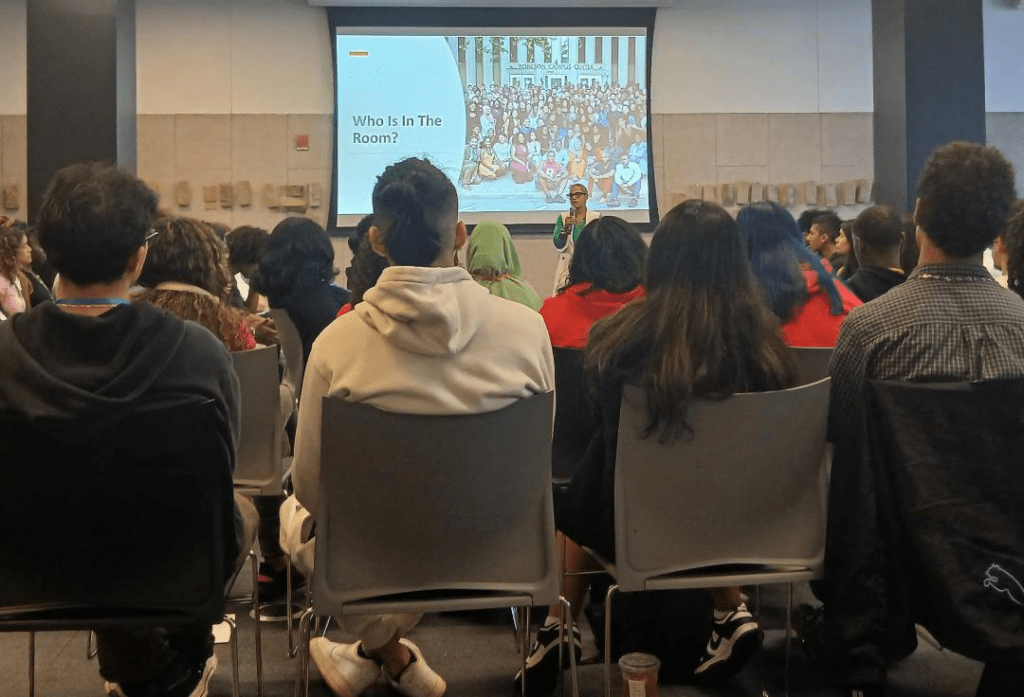
Most of them are towards the lower end of the “young people” spectrum, I’d guess average age 21. But their age is one of the few things I don’t know about their backgrounds. In a remarkable session titled “Who’s in the room?”, they were encouraged to identify themselves by a wide range of social characteristics. Most of them were “locals”, either coming from the city of Newark, or the surrounding New Jersey suburbs. That reflects Rutgers University’s aim to be an Anchor Institution, that’s genuinely connected to its local community. Implicit in this is a group that almost entirely comprises People of Color.
But these things tell only a fraction of their stories. When invited to share their ethnicities, a complex patchwork of identity was revealed. Almost all the young people had mixed heritage. One I spoke to described parents who were Indian German/Irish Jamaican. Another shared that both her parents were descended from Native Americans, but she was black – and a hijab wearing Muslim. One young man disclosed that both his parents are undocumented migrants. Another that he was born in Israel, but with family roots in Syria. Several identified as American, but also from a number of different African and Latin American countries.
About 80% of the young people described religion as having been an important part of their upbringing, although interestingly, a significant number of them said it no longer was, or that their current belief system was not the one they were brought up with. They were also invited to share their gender and sexual identity, apparently without any sense of embarrassment. As one person put it: “In many cultures of the past and now revitalising in some, there’s growing awareness and acceptance of identity outside of the binary”.
I’m not sure if Kamala Harris reads my blog, but if she does, this would make her day. Her invitation for Americans to see themselves in – and then vote for – her, would be fully vindicated by the rich diversity on display by the young people of Rutgers, Newark. However, Ms. Harris would be wrong to over-rely on this as a path to victory.
During a whole working day of discussion and disclosure, politics was barely mentioned. There were some allusions to the importance of the forthcoming elections, but they were mostly from the teaching staff. One scholar did share with me his frustration that politics was absent, but on the whole, it felt as though these young people have rejected binary choices in more ways than one. They were certainly politically conscious, but not in a way that translated to traditional party politics, or, for that matter, class politics. One young woman very eloquently expressed the thought that her vision of America was far more encapsulated by the range of people in the room, than the one represented outside it.
A more troubling aspect of my experience was a tendency towards platitudes. Partly, this reflects a UK-US cultural difference, but there was also a feeling that some Young Americans have learned to express what might otherwise be potentially contentions political ideas, in a way that is sanitised by soft rhetoric. Thinking back to watching the Democratic Party Convention, it’s clear they’re not alone! The air still seems to be leaking out of the Trump blimp, but the notion that he “tells it like it is” remains one of his few potent appeals.
Perhaps connecting some of these issues, the most jarring moment of yesterday came when one black woman, talking about her history, said “Can I mention slavery?”. After decades of apparent progress towards the USA coming to terms with its original sin (stealing the land in the first-place pre-dates the foundation of the nation), it was quite shocking to hear this subject still being treated as a taboo, even in the most accommodating of environments. That’s a serious problem in its own right. But it could also indicate that the gap between what many Americans are thinking and the legitimised public discourse is as wide as ever – and this may have consequences on 5th November and beyond.
 Letter from Newark, NJ
Leave a comment