I had my first teaching session at Rutgers University yesterday. I don’t have a lot to compare it with (I’ve only been working as a lecturer for a couple of years and it’s a long time since I was a student), but almost everything was different to what I’ve experienced in the UK. I expected that, to some extent, but the full scale of the contrast came as a shock – and a lot of that is cultural.
The Rutgers Honors Living-Learning Community (HLLC) is unusual, even by US standards. All the students (the word “scholars” is preferred here) and staff (including me) live in the same building. So, there’s a Big Brother House feeling that inevitably rubs off on the atmosphere around classes (not “lectures”).
From the start, there’s been a big effort to engender a team spirit. This comes from the top-down, but the scholars appear very willing participants. It’s a facet of US society I’ve noticed over many years, in different contexts, that people here tend to be more effusive, particularly in early encounters. European reserve was lost somewhere in the Atlantic crossing. This has been confirmed in my first two weeks at Rutgers. Most of the scholars appear supremely confident and eager to speak. By comparison, most UK students tend towards the Shakespearean, “creeping like a snail unwillingly to school”. Encouraging students to contribute to classes at home can feel tortuous. Here, there’s an expectation that everyone will contribute, perhaps a metaphor, albeit a flawed one, for the American way.
I should qualify that HLLC scholars are probably not typical. Getting a place on the course is very competitive and I assume there’s a deliberate effort to recruit extrovert, confident personalities. It’s too early for me to say whether this translates into academic ability, but another feature of the HLLC ethos is that scholars are frequently reminded that many others would take their place, given the opportunity. Again, this bootstrap mentality can jar on English ears, but is an intrinsic part of the national character, up to and including pending decisions about who to vote for.
An example of what goes on here was yesterday’s “Intention Circle”. The whole class of 80 went out into the HLLC building’s courtyard and stood in a circle. Scholars (and staff) were asked to select one word that summarised their intentions for the course. Each person then moved around the circle saying that word to everyone, in a continuous chain until all 80 had said their word to the 79 others. It took about 20 minutes and I found it a powerful and moving experience. You had to look each person you stood before straight in the eye and doing this, while just saying one word, created a connection that could have taken weeks. In a way, the actual words were incidental: what mattered was building a sense of community. There’s another flawed metaphor for the nation!
Back in the classroom, we introduced the first major topic for the course: “Freedom”. We’d selected a podcast from New York public radio discussing the contested meanings and interpretations of the word (well worth listening to, here) and asked the scholars to listen to it and reflect. You could have heard a pin drop. In my short time standing in front of classes, I’ve rarely had such a strong sense of a subject hitting home. Of course, it’s a word that forms a fundamental part of the American story and as the podcast says, is being retold as part of the Presidential election.
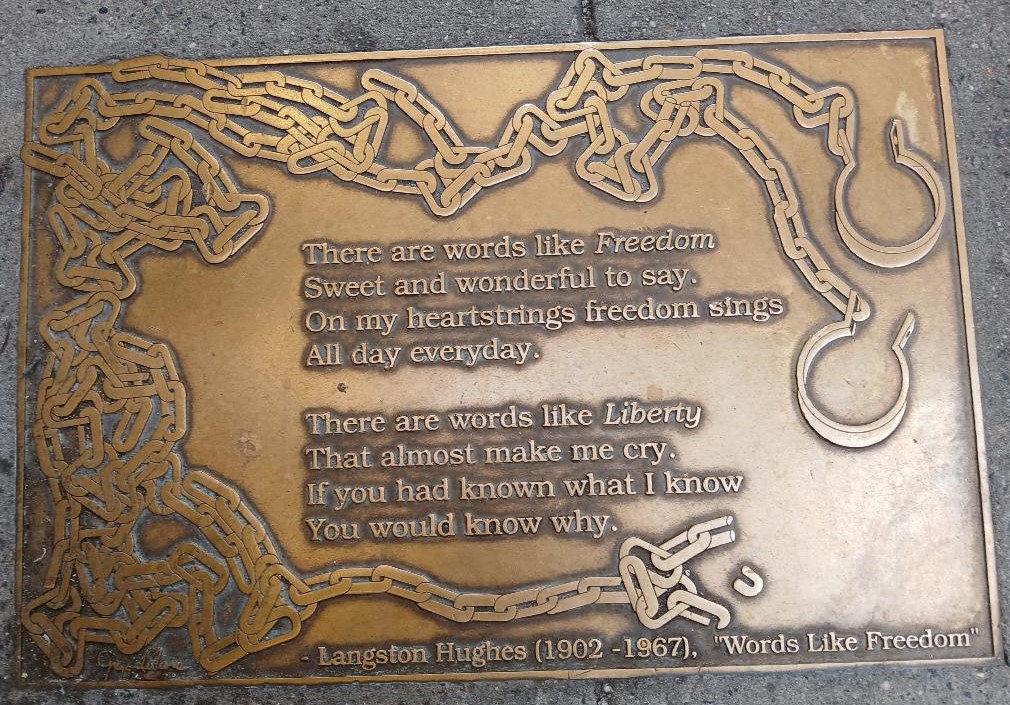
We’ll find out what the scholars made of it later in the week. My own thoughts turned to Doctor King and his view that “America has made progress towards freedom, but measured against the goal the road ahead is still long and hard” (The Nation, 15th March 1965). I also remembered seeing a plaque in the pavement of 41st Street in Manhattan with a poem by Langston Hughes.
 Letter from Newark, NJ
Leave a comment