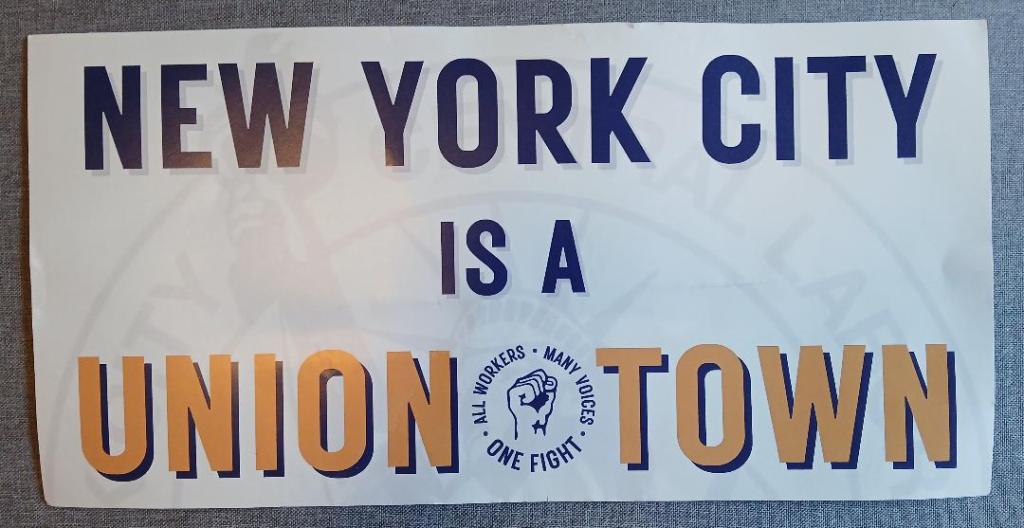
New York City celebrates its working class more than most places I know. There are reminders – murals, statues, memorials – throughout the city of who built it. It’s also a trade union city. Significantly diminished compared to its post WW2 heyday, but this is still a place where people wear their union membership with pride. All of this and more was on display at yesterday’s Labor Day parade. It was a vivid insight into NYC’s labour movement culture.
We joined the parade at 46th Street, just north of Grand Central station. One of the first things we saw was an instant corrective against any false expectations. Chuck Schumer, the Senate majority leader and one of the most powerful politicians in the land, was imperiously glad-handing union members, claiming to be a “friend of labor”. This was an early sign that Tammany Hall-like machine politics is alive and well in the relationship between NYC’s trade unions and the Democratic Party, particularly with an election coming.
The parade is just that. It’s not a march or a rally of the UK labour movement kind. Each “local” assembles separately and walks in a block, with its own heavily branded regalia of t-shirts, placards and motor floats. From a UK perspective, the level of cost and organisation is unimaginable. Clearly, part of the intention is to build a strong sense of member identity with their local (roughly the equivalent of a union branch). But there was almost no visible mingling of different locals. Iron workers marched with iron workers, postal workers with postal workers.
The format, with each block separated from the other, meant they may not even have been able to see each other. At the end, having passed by a grandstand of dignitaries at Central Park, each local dispersed and went their different ways.
Randomly, we walked with one of the plumber’s union locals, about 100 of them, some accompanied by partners and children, most wearing the commemorative t-shirt, bearing a rather elliptical quote from Abraham Lincoln: “If any man tells you he loves America, yet hates labor, he is a liar. If any man tells you he trusts America, yet fears labor, he is a fool”. They were of all ethnicities and that’s an important sign of progress. US labor unions (like others, but probably worse) have a terrible history of racism, especially in NYC’s construction trades.
But a less positive note is that it appeared fairly clear that these plumbers were being paid to parade! At the end, they were instructed to “sign out” and “collect their envelopes”. This is a thorny issue and again, one that is as relevant in the UK as the US. Over the years, my experience has been that renumerated activism, including at grassroots level, is more ingrained here than at home. That’s beginning to change, with far more professional “organisers” in UK labour and activist circles than there used to be, something I generally attribute to US influence. It’s not straight-forward. There are some good reasons why people who give a lot of time and effort to the cause should get paid. There are also dangers and making cash incentives to turn out on Labor Day doesn’t feel right.
I don’t know how many other unions were giving out envelopes, but it might have been in inverse proportion to the amount of life in each delegation. Some of the smaller locals, particularly of service and shop workers, were the most animated, as well as the most gender and ethnically mixed. By contrast, there was one contingent, with t-shirts reading “American Pride” carrying between them a huge American flag. Although, in general, overt nationalism wasn’t a feature of the parade, it’s never far away here.
Nor is the election, in 57 days. As well as Schumer, the Democratic Party’s state governor and city mayor were busy being seen. There was a sprinkling of Harris hats, but most New Yorkers voting Democrat on 5th November is assumed. One of the labourer’s unions had produced a big placard with Harris in red head scarf, flexing her muscles, from the famous Rosy the Riveter poster and reading “A Woman’s Place is in The White House”.
Almost absent from the parade were Palestine and the organised left. We had bumped into a small Palestine solidarity demo outside the main New York public library. There was some suggestion they were planning to join the parade too, but there was also condemnation of the official US union leadership for failing to make its voice heard about the mass slaughter of Palestinians – another UK similarity. But unlike almost any gathering of the UK labour movement, there were no obvious signs of the US/NYC left on the parade – no newspapers on sale, or leaflets being given out. This doesn’t mean that, for example, there were no Democratic Socialists of America (DSA) members on the parade, but I suspect many would regard the event as reflecting the dead-hand/dead-end of the union bureaucracy.
In many ways, the NYC Labor Day Parade was a walking metaphor for the contradictions and flux of US society and politics. There is a definite sense of shifting sands which, allied with a rejuvenated labor movement, could produce real change for good. But there are also obstacles that are likely to remain after 5th November, whatever the result.
All that being said, there was still something momentous, perhaps even portentous, about joining a parade of thousands of working class people and union members walking proudly and defiantly along 5th Avenue, home to the wealthiest of the wealthy.
 Letter from Newark, NJ
Leave a comment