To ensure I get my football fix, I’ve been watching the Rutgers University-Newark “soccer” teams. Obviously, this misnomer is one of the big problems with the game here, but there are others. College sport in the US is a different animal to its UK equivalent. It’s big business, particularly around the most popular games of American football and basketball, but filtering down to the relatively humble level of Rutgers-Newark. Sometimes, a couple of hours watching the Rutgers “Scarlet Raiders” can feel like a lifetime of trying to understand this peculiar country.
It starts with the stadium. I’ve been to lots of football grounds, but this is the first one named after a former slave. It’s good that the Scarlet Raiders play at Frederick Douglas Field, but this disguises a deeper truth.
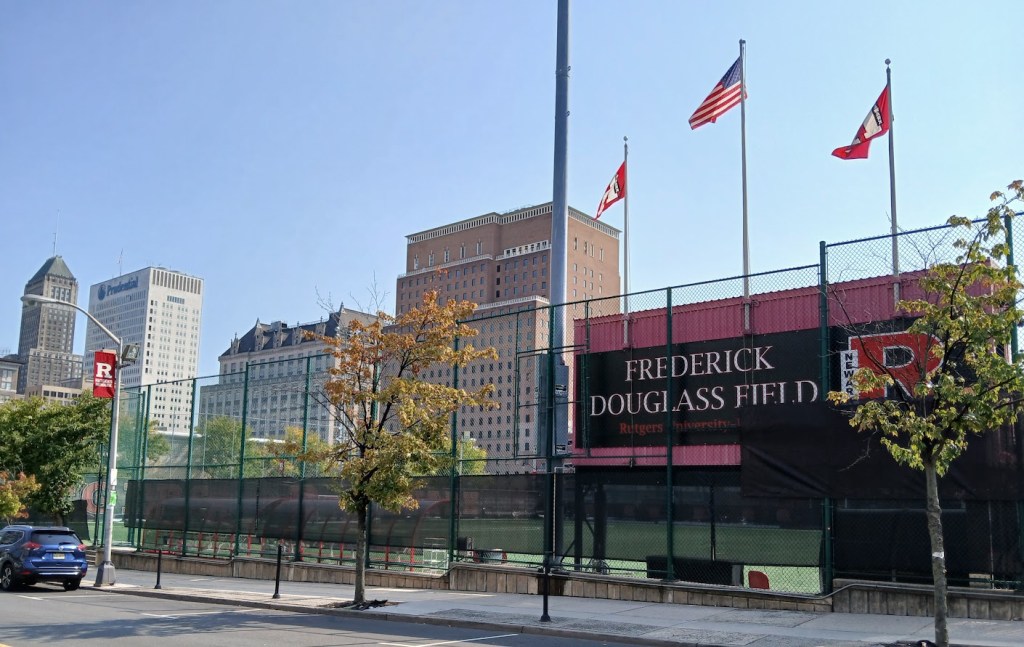
I’ve recently been to an exhibition capturing Newark’s hidden history. It’s a city that has very obviously been through a fairly recent physical transformation. Much more to say about that, but Rutgers University is one of the key agents driving an erasure of working class and African American history. So I wasn’t entirely surprised to learn that, on the site where Frederick Douglas Field now stands, there was once a building that was an important stage in the Underground Railroad, brilliantly captured by local artist Noelle Loraine Williams.

Organised sport is an ideological project everywhere, but nowhere more than in this country. I’m now resigned to hearing the national anthem at any game I go to, at any level. So again, I’m prepared to wearily and slightly shamefully get to my feet before kick off.
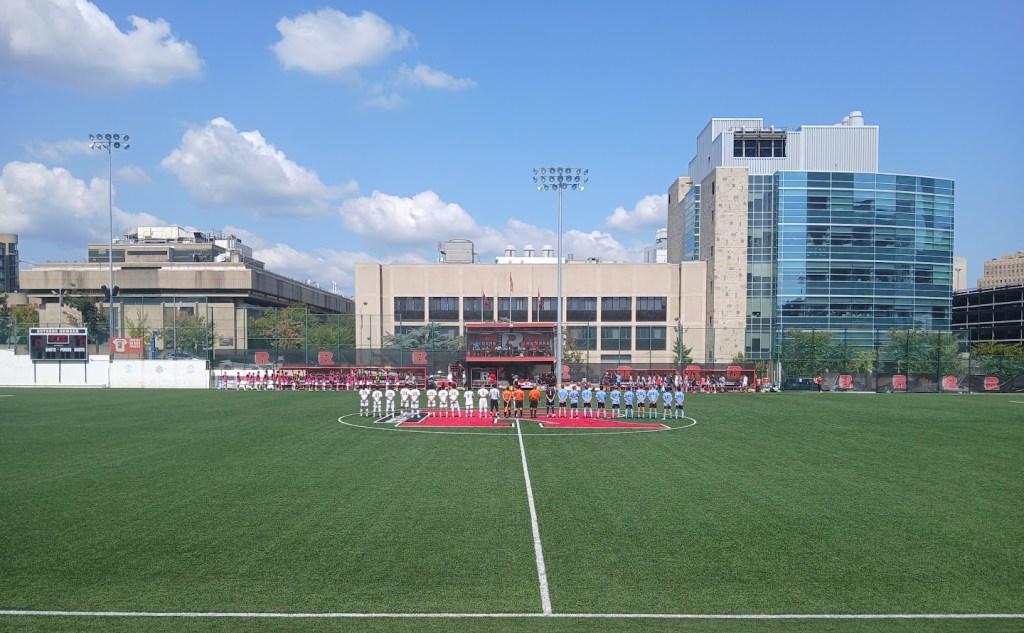
I presume these young men (I’ve been to see the Scarlet Raiders women’s team too and it’s basically the same) have had a lifetime of saluting the flag. Who knows what, if anything, it means to them? But I am often struck by the apparent need to constantly remind US citizens of their national identity, in case this might otherwise be in doubt.
Another feature of both the game and the country is the creation of personal hero narratives. There’s been plenty written about the often sad fate of faded High School sports stars. John Updike’s “Rabbit” novels come to mind. Newark’s own Philip Roth also features one in “American Pastoral”. But there’s something jarring about seeing all of the players, on both teams, individually announced over a loud PA as they trot on to the field. Some of them even wave and applaud the “crowd”, which is mostly below three figures.
This sense of sports ego inflation is amplified by the huge retinue of staff for teams like the Scarlet Raiders. They have eight coaches! That’s probably more than Leyton Orient (although they could do with them). The players also have support, from physios to laundry, to get them on the pitch feeling and looking their best. From what I can tell, all of these ancillary staff are on the pay-roll.
I played college sport in the late 1980s. Immodestly, I’ll say at a higher level than the Raiders. We had one part-time coach, who rarely turned up. We got our shirts and a bus to away games. Everything else was down to us.
I’m slightly ambivalent about all this because I think it’s good that all young people, not just college athletes, are helped to feel important and valued. I’m certainly seeing the merits of that in my Rutgers classes. But I do wonder where this can leave them when the music stops, particularly for those – the vast majority – who don’t stay in the limelight.
I had a really interesting discussion about this with one of my students. He’s also a college athlete, partly paying for his education through a volleyball scholarship (I doubt there are many of those in the UK either). This means, on top of his study, he spends four hours a day training. I asked where he thought this would lead. He knows earning a living from volleyball isn’t an option. But he’s happy to be spending lots of time playing his favourite game – and a future trying to get a job as a DC lobbyist for a progressive cause – while being really good when playing volleyball on the beach.
I shared my concerns about what becomes of college sportspeople. I wondered if they at least carry on playing recreationally. His reply confirmed my fears. They stop. With the exception of softball and “pick up” games of basketball, there is no real US equivalent to Sunday league football, or competitive amateur rugby, or netball. I asked him why. This time, his reply was even more worrying, but very insightful.
He said there’s really no place to go for most young Americans who bathe in the short-term glory of school or college sport. Unless they can join the super elite and play professionally, it’s over, before they reach their mid. 20s. He sees the social consequences in multiple ways, including the country’s terrible health problems. But he says the message is “if you’re not the best, you’re the worst” – and I fear that echoes way beyond the sports field.
 Letter from Newark, NJ
Leave a comment