With less than a month until the Presidential election, my mind is fogging amidst the welter of contradictions and conflicts. This country, which so proudly and repeatedly eulogises its political system, sometimes appears on the brink of complete political breakdown. This is reflected in the huge uncertainty and anxiety about what will happen on – and perhaps more importantly – after 5th November. What follows is, I believe, sometimes referred to as a “think piece”. Joining the national mood, I haven’t got a clue what’s going to happen. But I do see some clues in the tea leaves.
Growing up in my devoutly Communist, Cold War household, I was given lots of reasons to dislike the USA. The one I remember most clearly wasn’t colonialism, or Jim Crow. It was corruption. Based on I’m not sure what information, I was told this country and particularly its politicians, are inherently dishonest. It took me a while to realise political chicanery is universal. But there does sometimes seem to be something rotten in the States of America, making the abuse of power more prevalent.
26th September was an historic day in New York City. For the first time in 150 years, a serving Mayor was indicted for corruption. Eric Adams, a former policeman, has been accused of a staggering list of crimes including bribery, soliciting illegal campaign funds, defrauding public money and accepting a bunch of freebies that might even embarrass Sir Keir Starmer. It appears a lot of the backhanders came from Turkish business interests – “Perks from the Turks”. Disgracefully, Adams is said to have waived fire safety requirements on a new building being developed by his cronies and also agree not to refer to Armenian Genocide Remembrance Day.
Of course, Adams is presumed innocent, although it’s hard to see how he can stay in office while facing such serious charges. From an outside perspective, I’ve always sensed something a bit iffy about him. Alongside vacuous statements about “community”, he never misses an opportunity to express his uncritical support for his former colleagues in the NYPD, even in their most violent excesses. He’s also stuffed his senior staff with friends and relatives. Several members of his administration have resigned in the last few weeks, presumably seeing what was coming (some of them apparently scrambling to protect their pensions).
Time will tell how dodgy Adams is. But his case exemplifies a feature of this nation dating back to its formation. The new, blood-soaked, improvised and fretted-over post-colonial settlement created tensions that endure. The vast scale of the endeavour meant a lot happened thousands of miles away from the lofty ambitions of the Founding Fathers (sic) and their aims for the separation of powers and judicial oversight. The original sin of compromising on slavery established a precedent of abuse that often seems to persist. Perhaps, once you’ve bent the stick on that, everything else comes more easily? Mass communication may have annihilated space by time, but there is still a profound sense that this is a place where local autonomy can come at the price of transparency and accountability. Interestingly, I’ve recently heard it argued (as it also could be in the UK), that one of the inhibitors of corruption – a robust, independent local media – has now virtually disappeared, to be replaced with the new Wild West of social media. Now, the whole concept of “Democracy” (which some of the aforementioned founders were doubtful about from the start) is being questioned. The most likely result of the 5th November elections is a cry of “unfair”.
The Adams case illustrates the most obvious reason why US politics is so corruption prone. It is institutionally infected with big money. Years ago, I talked to someone who was considering running as Mayor of a medium sized US city. He had quite a lot going for him, including being pretty well off. But he said that, unless you had at least a million dollars to spare, mounting a successful campaign was impossible. Almost by definition – and of course, there are exceptions – anyone holding a high-profile political position in the US is wealthy, or if not, susceptible to financial influence, or both. Hence the huge power of lobbyists, Political Action Committees (PACs) and the notion that US politics revolves around a “pay to play” culture.
Some of these issues are more acute in certain places, including New York City (NYC). A few weeks ago, I stood at the grave of William M Tweed at the splendid Wood-Green cemetery in Brooklyn. “Boss Tweed” was the most notorious leader of Tammany Hall, the fraternal association that held huge influence over NYC politics from the mid. 1800s to the early part of the twentieth century. Tammany’s power derived from a highly organised political machine, overtly or covertly linked to the Democratic Party and some trade unions. Tammany’s control of City Hall jobs and contracts was particularly, but not exclusively, centred on the immigrant Irish community. I have had several conversations with New Yorkers in the last few years who believe that while Tammany may not exist anymore, its practices do. Eric Adams may be the latest evidence of this. Lest we forget, Trump is a New Yorker.
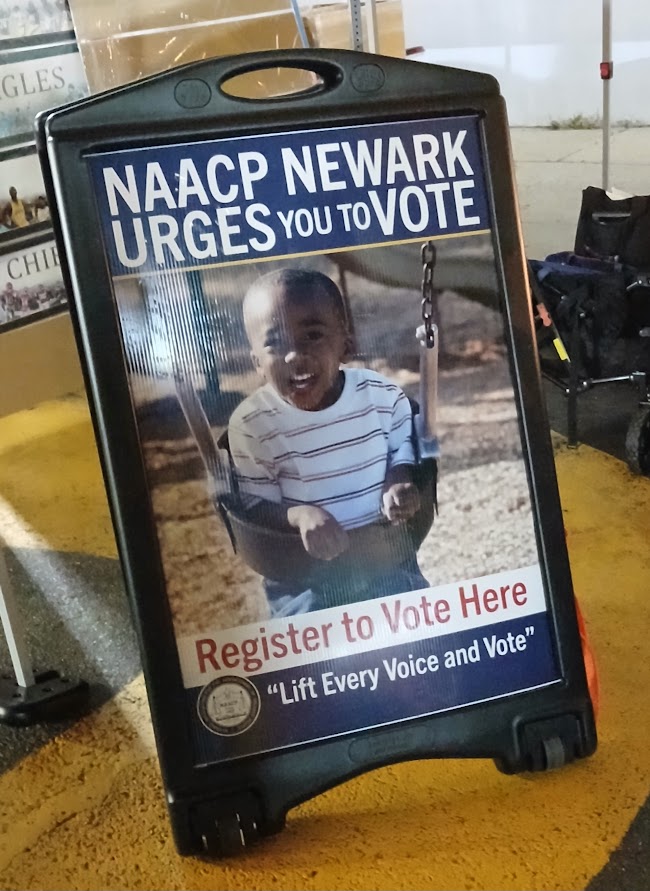
But NYC is not alone. New Jersey, where I’m writing this from, has a long, but continuing, history of political corruption. Newark, the city I’m in, has seen several of its past Mayors prosecuted for it and there is currently a grim sounding case in Camden, in the south of the state. Down the road, Mayor Frank Hague controlled most things that moved in Jersey City for forty years. But almost every 19th century industrial US city had a similar “Boss Mayor”, who traded probity for “getting things done” (one of Mayor Adams’ favourite maxims) and earning voter loyalty. Across the country, in Harris’ home state, there has been a scandal of political corruption in Los Angeles, driven by speculative property developers. Lest we forget, Trump is a property developer.
All of this speaks to the credibility of the US political system at a time when it has rarely been under more strain. There has been some suggestion that Trump may try to exploit Eric Adams’ travails to highlight the misdeeds of the Democrats. He’d be throwing stones from a very big, rotten glasshouse. We discuss these issues often in my Rutgers classes and although I still find the scholars a source of hope, they are deeply disillusioned about their nation’s politics. Despite their mostly highly politicised and radicalised sentiments, I would still be surprised if more than half of them actually vote in the Presidential election. Several of them have said they see no future in the national duopoly and are concentrating their activism at local level.
This localist sentiment is intriguing, particularly in the US context. Kamala Harris has repeatedly proclaimed the US as “heir to the greatest democracy in the world”. From the outside, given all the problems, it’s hard to know what she could possibly mean by this. However, I have begun to see the country’s political system as very wide, but very shallow. There are elections here for almost every imaginable political position, from town sheriff to local school or water board. It is, in this sense, a participative democracy. But not many people participate! Apparently, two-thirds of these thousands of elections have only one candidate and presumably, this is reflected in voter non-turnout.
It’s this deep sense of detachment, sometimes referred to as the “democratic deficit”, that is most apparent to me now. I remember once talking to an Italian about how her country had allowed Silvio Berlusconi to dominate for so long. Her response was “He’s nothing to do with us”. She talked about her life in a smallish Italian town which basically functioned, with adequate services (albeit some of them controlled by the Mafia) and a reasonable, if constantly under pressure, level of economic prosperity. Who was President was irrelevant. I wonder if something similar could herald the return of Trump.
But other issues in the election could prove decisive. There’s the Middle East, particularly in the key swing state of Michigan, with 200,000 Muslim voters. This morning, I heard a woman of Palestinian origin say she’ll be voting for Trump because, even if he’s only offering a 99% chance of stopping the slaughter, it’s better than the 100% certainty that Harris won’t. In the last 24 hours, I’ve met genuine, active, experienced leftists who say there’s no real difference between Trump and Harris, so they won’t be voting for her, partly as punishment for Gaza. I understand that, but disagree. Being here is to be constantly chilled by the level of Trump’s racism. It’s now very clear that he’s pinning most of his hopes on the notion that, if elected, he will instigate a programme of mass deportation of illegal immigrants. And yet, there is still significant polling suggesting that many Hispanics, whose kith and kin will be the main target, plan to vote for him. I don’t see many signs that the so called “culture wars” are cutting through. But one of Trump’s current attack ads says “Kamala isn’t for you, she’s for they/them” – a slogan that could appeal to several different prejudices. Harris has definitely lost the Newark barber vote. I met my second today, another African American who will be voting Trump, not because he’s a man, like the last one, but because Trump appeals to him as an anti-establishment underdog. In the end though, I hope – and just about believe – that defence of reproductive rights will carry the day on 5th November. But that could just be the end of the beginning.
Speaking of ends, as parts of the country try to recover from yet another “once in a lifetime” weather event (Hurricane Helene), with the next one possibly due later this week, the thing that’s not being discussed by any of the candidates, is climate change. This certainly isn’t an example of American exceptionalism. But even viewed from the limited perspective of Newark, which is surrounded by water and where there were deadly floods as recently as 2021, the sense of denial is palpable.
The US novelist William Dean Howells said the American public wants “a tragedy with a happy ending”. It’s a neat quote and I see his point. But I fear only half of it will come to fruition in the near future.
 Letter from Newark, NJ
Leave a comment