The last four months have been a whirl. From teaching at Rutgers, to discovering Newark’s idiosyncrasies: meeting some brilliant people and renewing my vowels with New York City, all with the spectre of Trump looming.
The Honors Living Learning Community (HLLC), where I was based, has sometimes felt like an educational Shangri-La. The freedom to explore issues of social justice, racism and the legacy of slavery has felt almost illicit. Of course, these are things we should be talking about, in and out of the classroom. But they conflict with a system where conformity is back in fashion.
Some weeks ago, parts of downtown Newark became a location for a film set in the late 1950s (I believe it’s a biopic of localish lad, Bruce Springsteen). When I went to my favourite local bar, The Kilkenny, the streets were full of actors in period costume, leaning against classic big-fin cars. It was weird walking through a fantasy-scape that some people, including the next President, want to make a reality. One of the starkest moments of my classes was realising none of the students really knew about J. Edgar Hoover or McCarthyism. They could soon meet their 21st century revivals. There is much speculation about what Trump may, or may not, do. But there are clear warnings that challenging conservative orthodoxy will be punished. There are already reports of right-wing groups drawing up lists of domestic “enemies”.
In some ways though, the election was an anti-climax. I’d expected a much stronger reaction, on all sides. Partly because of the pathetic Democrat campaign, in the end, it felt almost routine that a reactionary, racist, sexist bigot would fill a political vacuum, again.
There’s a view that he didn’t do much in his first term and won’t do much in his second. I’m not so sure. By winning the popular vote and with significant Republican swings from sections of the working class, he could feel emboldened with Thatcher/Reagan-like authority. The first major domestic conflict, particularly if it centres on a labour dispute, will be very significant. Likewise, the extent to which his promised “mass deportations” meet local resistance.
At times, Newark has seemed like a different country. It’s hard to convey just how odd it can feel. For a city with a population of 300,000, it sometimes appears semi-abandoned. I’ve been on walks, through central neighbourhoods, lasting 2 – 3 hours and barely seen anyone. At a guess, I’d say a quarter of the downtown shops and buildings are empty. There was only one supermarket within a two-mile radius of where I was staying, in the centre of the city (and that was a Whole Foods, which tells its own story). Finding somewhere to eat at certain times could be tricky, similar to the Sundays of my childhood. There isn’t a single cinema in central Newark. In a city with a rich cultural tradition, finding out what other entertainment is on can also be difficult. A lifelong Newark resident (who shares my frustration) says it’s a place where “if you know, you know”.
There are some plausible explanations for all this. Newark does have a “reputation problem”. When I told people where I was staying, there was almost always a raised eyebrow in response. Even some of the people I know who live there, seem to have internalised the idea that it’s dangerous to walk the Newark streets, especially at night. Partly for this reason, but also the massive suburban exodus, Newark is horribly car dominated. There are dozens of car parks in the downtown area. These become “dead space” after 5pm and at weekends. The sense of depopulation also reflects Newark’s mass destruction of its inner-city public housing, where thousands of people used to live. Having failed to learn the lessons from numerous other places, City Hall is continuing to knock down its public housing, most recently Seth Boyden Terrace. I’ve seen numerous abuses of public housing, but at Seth Boyden, the current plan is to replace 530 homes with a film studio! (The cleared site has now been empty for two years, with no certainties about when, of if, redevelopment will happen.)
All the city’s problems (and potential) collide at Newark Penn, its splendid, 1930s, railway station. Leaving aside the chronic unreliability of the trins that run through it, the station is effectively an auxiliary shelter for the homeless. With its warren of passages, it’s impossible to be accurate, but scores of people, perhaps even a hundred, are there throughout the day – more in the evenings and when it gets cold. It appears that a self-help community of sorts has developed. The men, quite rightly, use the station’s public toilet as their bathroom. Some of them beg, but in my experience, none are a threat, although a number, unsurprisingly, seem to be suffering from mental ill-health. Most just seem to use the station as a warm and relatively hassle-free refuge. The police are almost always present, but apart from the occasional performative “move on” order, they seem to share the general sense of resignation at this waste of human life. It’s perhaps superfluous to add that most of the people concerned are African American men.
But Newark Penn’s social cleavage doesn’t end there. Just outside the station, to the west, is The Gateway Centre, a complex of offices, restaurants and shops, connected by a series of overhead walkways that also link to the Hilton Hotel and the Prudential Centre, a conference venue where the New Jersey Devils ice-hockey team also play. It took me a while to realise that people who work in the Gateway Centre can commute to and from Newark Penn and never need to set foot on Newark soil. Access to and from the centre is monitored by armed guards. I didn’t see any homeless people there. Strolling through this sterile environment, where a noticeable number of the retail outlets are unoccupied, it’s immediately obvious that there are far more white people present than other parts of downtown. This becomes even more obvious when the Devils are playing the “whitest” of north American sports. The Gateway Centre presents a form of social segregation by design that Robert Moses would have been proud of.
But if you leave Newark Penn’s eastern side, a very different urban landscape appears. The Ironbound, a name evoking a time when Newark made something other than, (possibly) films. The neighbourhood buzzes with life, shops and restaurants, mostly resulting from its large Portuguese and Latino population. It gives a sense of what Newark’s other working class communities must have been like, before the wrecking balls arrived. That said, the Ironbound, bordered on one side by the Passaic River, is also the prime location of Newark’s grotesque history of industrial pollution. It seems only some robust municipal intervention prevented the city from a similar fate with its drinking water as Flint, Michigan.
Another aspect of what Newark is, is what it is not. Being a post-industrial city in the shadow of New York City (ten miles away) must make scrabbling for recovery and reinvention even harder, particularly when other nearby New Jersey cities have attracted some of the financial magic beans. Hoboken is sometimes referred to as NYC’s “sixth borough”. Parts of Jersey City have been called the Gold Coast since large-scale property speculation, including several buildings bearing the name “Trump”, landed on its Hudson River frontage and spread inland. Newark’s urban entrepreneurs apparently live in hope that, eventually, some of NYC’s riches will wash up on the banks of the Passaic.
I saw one Newarker wearing a T-shirt reading “Fuck New York. I like it here”. I get that. But I must admit that during my time in Newark, I went into NYC several times a week – and fell in love, yet again. I can’t fully justify or explain this, but the excitement I felt on my first visit in 1986 hasn’t diminished. Cliches about diversity and vibrancy are part of it. I have a sense that I could never get bored there. Sometimes I even think I could never die there because there’d always be something to do. It’s not for everyone, but I find NYC a constant source of invigoration.
Sadly, so does Donald Trump. Although he has taken “phony” to new levels, he is a genuine New Yorker, albeit one personifying its worst qualities. Among the many interesting and worrying features of the November elections was a significant NYC swing towards Trump. There are multiple possible reasons for this, all of which reflect the abject failure of the Harris campaign. I doubt this is a generational shift, but nor is it a fluke. The early signs of Trump’s second coming look more like something from the House of Medici than fascism. But until or unless a political force emerges in the U.S. that offers a genuine alternative, the threat of a move even further to the right remains.
The same can be said of Britain. My time away has convinced me of one thing: this country is, once again, treading in the shitty footprints of the U.S. I haven’t been around to witness the incipient disaster of the Labour government, but similarities with the Democrats are palpable. I hope I’m wrong about this (and I often am), but I fully expect a Trump-Musk fuelled Farage to seriously vie for power at the next general election. Short of an economic miracle, America’s present is Britian’s near future. I still believe, in both countries, there are enough sinews of resistance to prevent a full descent into barbarism, but more than ever, there is a fierce urgency of NOW!
(By the way, I’m back.)
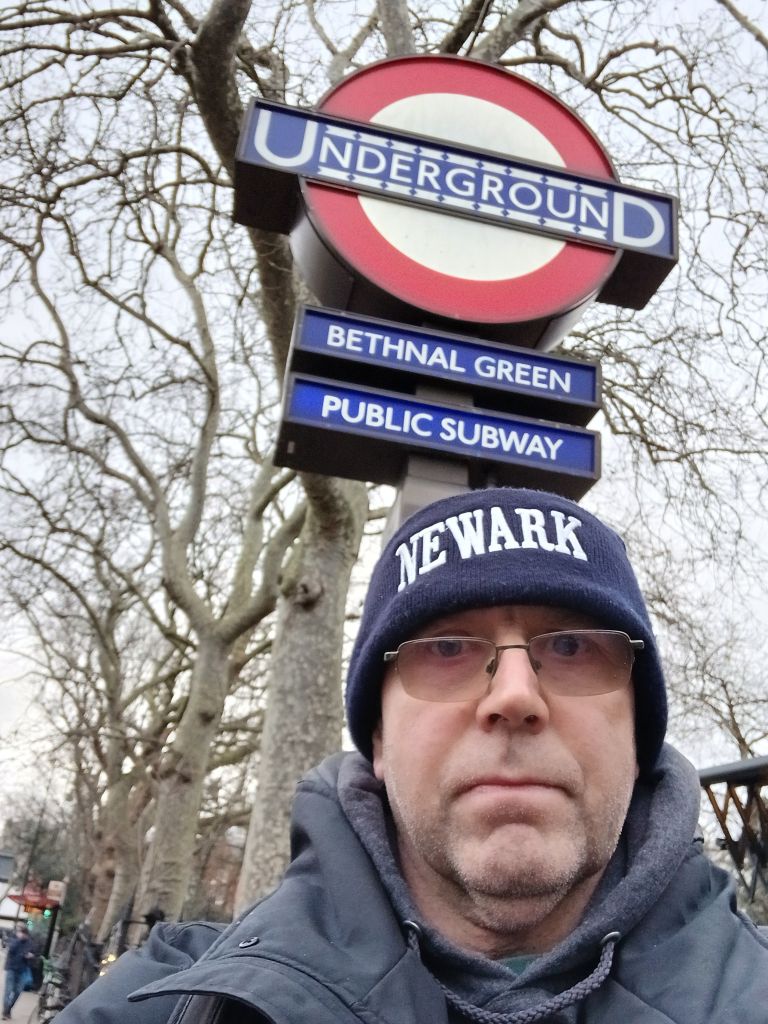
 Letter from Newark, NJ
Leave a comment